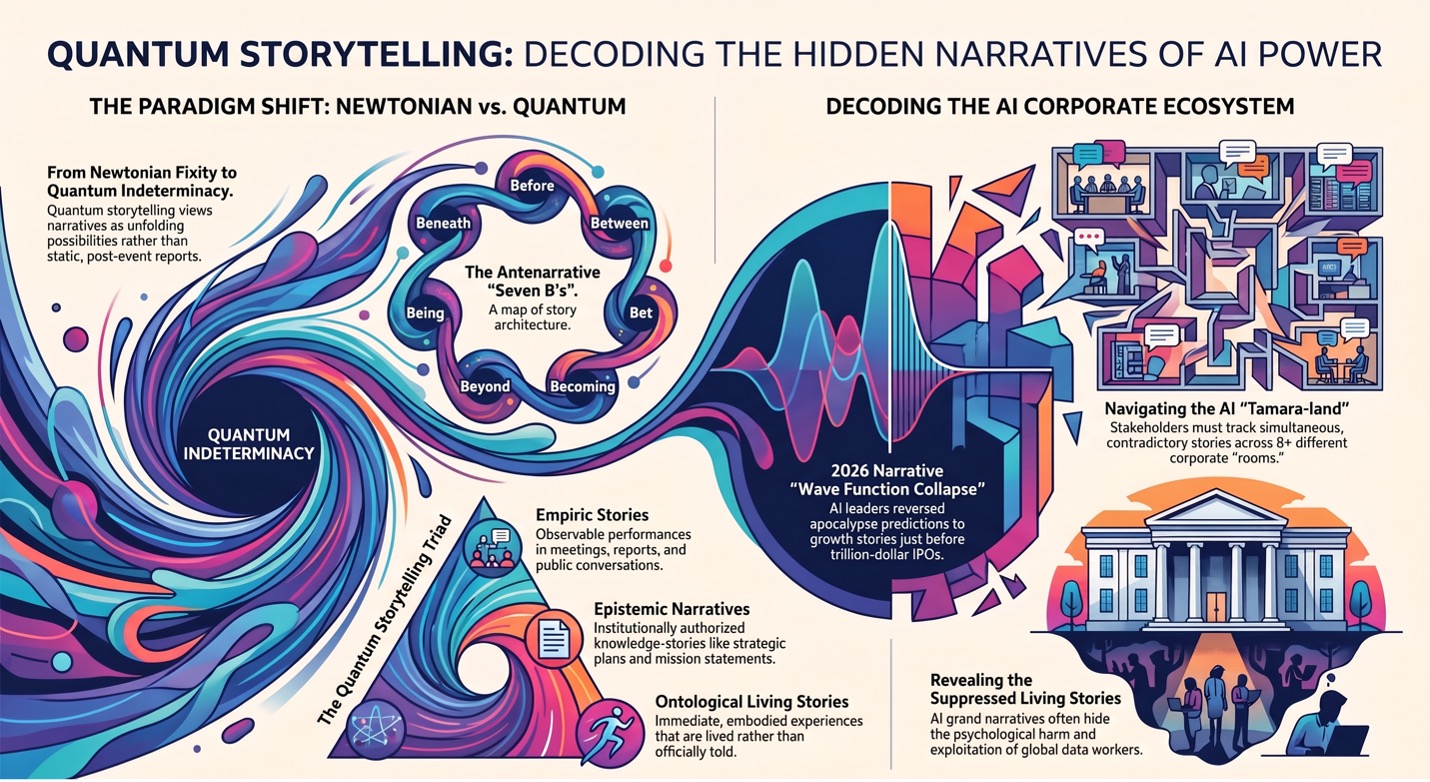

Tamara is a 1981 Canadian play by John Krizanc, set in 1927 Italy in the mansion Il Vittoriale of poet Gabriele D'Annunzio. What makes it radical: the audience does not sit in seats. Instead, ten characters perform simultaneously in ten different rooms. Each audience member must choose which room to enter, whose story to follow. No two people see the same play.
This became Boje's foundational metaphor for storytelling organizations: organizations are not single stories, but Tamara-Land — simultaneous performance in many rooms. Meaning is a function of your pathway.
Tamara is more than a play — it is a methodology for polyphonic, fragmented storytelling in organizations, now extended to the digital multiverse where people are in different rooms on cell phones worldwide, yet you can only be in the room you are in.
6 rooms → 6! = 720 ordered pathways. Total pathways Σ P(6,r) = 1,957. In the digital multiverse, rooms splinter, twist, and persist via SEAM and PERVIEW refrains. Or step directly into a room:
Tell us which rooms you want opened next or just ask David Boje a question →
David Michael Boje is Emeritus Professor of Management at New Mexico State University, where he earned the Regents and Distinguished Professorships before his retirement in 2018. He also serves as Visiting Professor at Fisk University. He holds a Ph.D. from the University of Illinois (1978). He is the founding editor of Tamara: Journal for Critical Organization Inquiry and originator of antenarrative theory and quantum storytelling.
With an h-index of 60, he has authored more than 300 peer-reviewed journal articles and 24+ books. His work spans four decades of research on storytelling organizations, True Storytelling methodology, and critical organizational inquiry. In 2025, he received the Organization Development & Change Lifetime Achievement Award.
He rides his horse Fancy in New Mexico.